India’s Students vs the World The Young Indians Winning Gold
India’s Students vs the World
The Young Indians Winning Gold
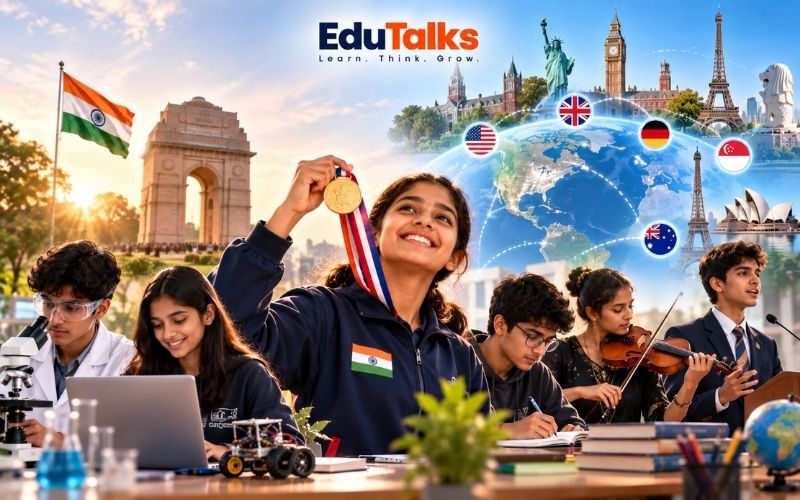
From mathematics and science to robotics, coding, debate and sport, Indian students are stepping onto international stages and returning with medals, trophies and something even more valuable: proof of what young minds can achieve.
```Somewhere in India, a student is probably solving a problem right now that most adults couldn't solve.
Another is building a robot.
Another is preparing for an international mathematics competition.
Another is debating an idea with students from five different countries.
And another is training before sunrise for a competition where the Indian flag will be on their uniform.
We often hear about India's biggest examination results. We hear about board toppers, entrance-exam ranks and college admissions.
But there is another side of Indian student achievement that deserves attention.
Young Indians are competing with some of the brightest students in the world—and winning.
Their stories tell us something important about talent, preparation and what education can look like when curiosity goes beyond the textbook.
A medal is only the headline
When a student wins an international competition, the result usually appears in one sentence.
“India wins gold.”
But behind that sentence can be months—or years—of preparation.
Practice problems. Failed attempts. Mentors. Teachers. Parents. Early mornings. Weekends spent preparing. Competitions where the student didn't win.
The medal is visible.
The invisible work is the real story.
The international classroom is much bigger than a classroom
When people hear “academic competition”, they often imagine mathematics or science olympiads.
Those competitions are certainly important. Indian students have a long history of strong performances in international Olympiads across mathematics, physics, chemistry, biology, astronomy and informatics.
But today's global student competition extends far beyond traditional academic subjects.
What makes these students different?
Not every international winner is naturally gifted.
And not every brilliant student becomes an international champion.
That's because high-level competition requires a combination of ability, opportunity, preparation, mentorship and persistence.
One quality appears again and again:
They become comfortable being uncomfortable.
```They don't panic when the problem looks unfamiliar. They don't expect every attempt to work. They learn to stay with a difficult question longer than most people are willing to.
```They aren't always the students with the highest marks
This is an important distinction.
School examinations and international competitions measure different things.
Marks can measure how well a student understands and reproduces the required curriculum. Competitions may demand creativity, problem-solving, speed, originality or the ability to tackle a problem the student has never seen before.
A student can be excellent at one and not necessarily dominate the other.
Education becomes richer when students get opportunities to demonstrate more than one kind of intelligence.
India is not competing alone
International competitions are valuable partly because they remove the comfort of comparison within one school or one city.
Suddenly, the benchmark changes.
You're not simply asking, “Am I the best in my class?”
You're asking:
Can I solve problems at an international level?
```Can I communicate with students from other education systems?
What can I learn from people who approach the same problem differently?
```That is a powerful educational experience—even when the student doesn't return with a medal.
What if schools measured curiosity too?
A school does not need to produce international medal winners to create an international mindset.
It can begin much earlier: with open-ended questions, science projects, coding clubs, debate societies, mathematics circles, reading programmes, maker spaces and opportunities for students to present their ideas.
Most importantly, students need permission to attempt things they might fail at.
A school that only rewards correct answers can accidentally teach students to avoid difficult questions.
```The teacher behind the medal
Student success stories often put the spotlight on the student.
But look closely and there is often a teacher, coach or mentor somewhere in the story.
Someone noticed the student's curiosity.
Someone gave them a harder problem.
Someone said, “Try again.”
Someone helped them understand that getting an answer wrong isn't the same as being bad at the subject.
Great teachers don't simply prepare students for competitions. They teach students how to think when the answer isn't obvious.
Don't turn every competition into a career decision.
A student doesn't need to win a gold medal for a competition to be worthwhile.
Sometimes the real benefit is discovering a subject they love. Sometimes it is learning to perform under pressure. Sometimes it is meeting students with different perspectives.
And sometimes the student loses.
That can be valuable too.
Competition should expand a child's world—not become another source of fear.
```You don't have to be “the topper” to compete with the world.
You need curiosity, preparation and the willingness to keep working when the problem doesn't immediately make sense.
```What India should really celebrate
Of course, medals matter.
They represent achievement, discipline and years of work.
But if we celebrate only the final medal, we miss the bigger lesson.
The more important question is:
How do we create an education system where millions of students get the opportunity to discover what they are capable of?
One international champion is inspiring.
A school full of curious students is transformational.
The lesson isn't “study harder”
That would be too easy.
The stories of high-performing students are rarely just stories about studying more hours.
They are stories about deliberate practice, good mentorship, curiosity, resilience, feedback and the willingness to work on something that doesn't have an immediate answer.
Those qualities matter far beyond competitions.
They are exactly the qualities students will need in a world where many answers are already available at the click of a button.
The world doesn't need students who are afraid of difficult questions.
It needs students who are curious enough to ask them, brave enough to attempt them and persistent enough to keep going when the first answer is wrong.
```India's young achievers are already showing us what is possible.
The challenge now is bigger than winning the next medal.
It is making sure that the next student with extraordinary potential gets the chance to discover it.
In 30 Seconds
```- Indian students compete successfully in mathematics, science, coding, robotics, debate and sport.
- International competitions test more than textbook knowledge.
- Preparation, mentorship, persistence and opportunity often sit behind a medal.
- Students don't need to be conventional toppers to excel in a specialised field.
- Schools can build an international mindset through curiosity, projects and problem-solving.
- Parents should value learning and growth, not only medals and rankings.
International Mathematical Olympiad — Official Results & Information
International Science Olympiads — Official Competition Information
Ministry of Education, Government of India — Student & Education Initiatives
```