She Teaches Biology Differently Using Messi, Schumacher & Real Life
She Teaches Biology Differently
Using Messi, Schumacher & Real Life
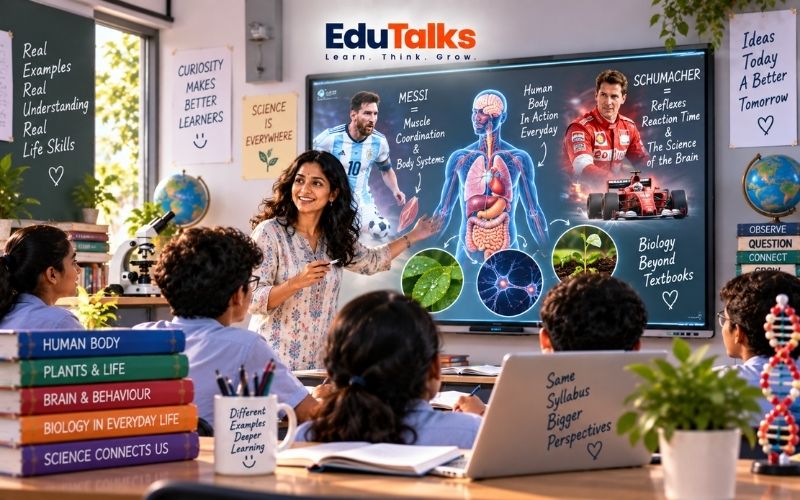
What if a Biology class started with Lionel Messi, moved to Formula 1, and somehow ended with students understanding the human body better than they did from a textbook?
```“Open your Biology textbook to page 74.”
For generations of students, that sentence has been the beginning of a lesson.
But imagine hearing something completely different:
“What makes Lionel Messi's body so effective at changing direction?”
Suddenly, everyone is listening.
The question sounds like football.
The answer is Biology.
And that is exactly the point.
What if Biology is already happening around us?
We sometimes make school subjects feel like separate rooms.
Physics is in the Physics classroom.
Chemistry belongs in the laboratory.
Biology lives inside a textbook diagram.
But the real world doesn't work that way.
Your heartbeat is Biology.
The way a footballer accelerates is Biology.
Muscle recovery after a race is Biology.
The effect of sleep on concentration is Biology.
Even the food students eat before an examination connects directly to how the body functions.
A great teacher doesn't always bring the real world into the classroom.
Sometimes, they simply show students that it was already there.
Start with Messi. End with science.
Lionel Messi is famous for his extraordinary control, acceleration, balance and ability to change direction quickly.
To a football fan, that's magic.
To a Biology student, it can become a lesson.
What is happening inside the body?
```Muscles contract. Nerves transmit signals. The brain processes information. The skeletal system provides structure. Energy is produced and used. Balance and coordination are constantly adjusted.
```Suddenly, terms that might have looked abstract in a textbook have a reason to exist.
Students aren't just memorising what the nervous system does. They're asking why a footballer can react so quickly.
Then bring in Schumacher
Formula 1 creates another unexpected classroom.
Michael Schumacher spent years operating at extraordinary levels of concentration, reaction and physical control.
Ask students what a racing driver needs and the answers quickly become scientific.
The lesson hasn't become easier.
It has become interesting.
Students rarely hate learning.
They often hate learning something they can't see the point of.
Why real-life examples work
The human brain naturally looks for connections.
When a new idea connects to something we already care about, it becomes easier to understand and remember.
A student who loves football already understands what it means for a player to accelerate, change direction and recover after a match.
The teacher's job is to connect that experience to the science behind it.
The same approach can work with almost anything.
Cricket? Talk about biomechanics, reaction time and energy.
Cooking? Talk about digestion, nutrition and microorganisms.
Gaming? Talk about vision, reflexes and the brain.
Sleep? Talk about memory, hormones and recovery.
The classroom becomes a conversation
Once students recognise Biology around them, something interesting happens.
They start asking their own questions.
“Why does my heart beat faster before an exam?”
“Why do athletes need different diets?”
“Why does lack of sleep make it harder to concentrate?”
“Why does the body shake when we're nervous?”
Those questions may not appear exactly that way in the textbook.
But they can lead students directly back to the science.
This isn't about turning every lesson into entertainment
There is an important difference between making a class entertaining and making it engaging.
Entertainment asks:
“How do I keep students amused?”
Good teaching asks:
“How do I make students want to understand this?”
A football example is useful only if it helps students understand Biology better.
A Formula 1 example is useful only if it leads to better questions.
The story is the hook. The learning is the destination.
You don't need expensive technology.
A teacher doesn't need a smart classroom, expensive laboratory equipment or complicated software to make learning more relevant.
Sometimes the best teaching tool is simply a question.
“Why does this happen in real life?”
Start there.
Connect the answer to the curriculum. Then let students take the conversation somewhere unexpected.
```Give teachers room to teach creatively.
A curriculum matters. Assessments matter. Academic standards matter.
But teachers also need enough freedom to connect those standards to the world students actually live in.
Encourage teachers to bring current events, sport, technology, local problems, popular culture and student interests into their lessons wherever appropriate.
A classroom doesn't become less academic when it becomes more connected to real life. It can become more meaningful.
```Try this the next time a lesson feels boring.
Don't immediately ask, “Will this come in the exam?”
Ask, “Where do I see this in real life?”
```Learning doesn't stop when school ends.
The next time your child watches a football match, follows a Formula 1 race, cooks a meal or asks why they feel tired, there may be an opportunity to turn that moment into a question.
Curiosity is one of the cheapest—and most powerful—educational tools a family can give a child.
```Maybe the problem isn't Biology
Ask a student whether they like Biology and the answer may depend on what they imagine when they hear the word.
If they imagine memorising diagrams, terminology and long answers, the subject can feel heavy.
If they imagine understanding how an athlete performs, how the human body adapts, why sleep affects memory, or how nutrition changes performance, Biology suddenly feels different.
The subject hasn't changed.
The student's relationship with the subject has.
The best classroom may not be the one with the most technology.
It may be the one where students suddenly look at something they see every day and realise, “Wait… that's science.”
```Messi can become a Biology lesson.
Schumacher can become a Biology lesson.
A football match can become a Biology lesson.
A student's own body can become a Biology lesson.
Because education becomes powerful when students stop seeing knowledge as something that exists only inside a classroom.
The world is already full of lessons.
Great teachers teach students how to notice them.
In 30 Seconds
```- Real-life examples can make difficult Biology concepts easier to understand.
- Sport provides natural connections to muscles, nerves, energy, reaction time and human performance.
- Using real-world examples is about deeper learning, not simply making classes entertaining.
- Teachers can create engaging lessons without expensive technology.
- Parents can encourage children to connect everyday experiences with what they learn in school.
- Curiosity can turn ordinary moments into opportunities to learn.