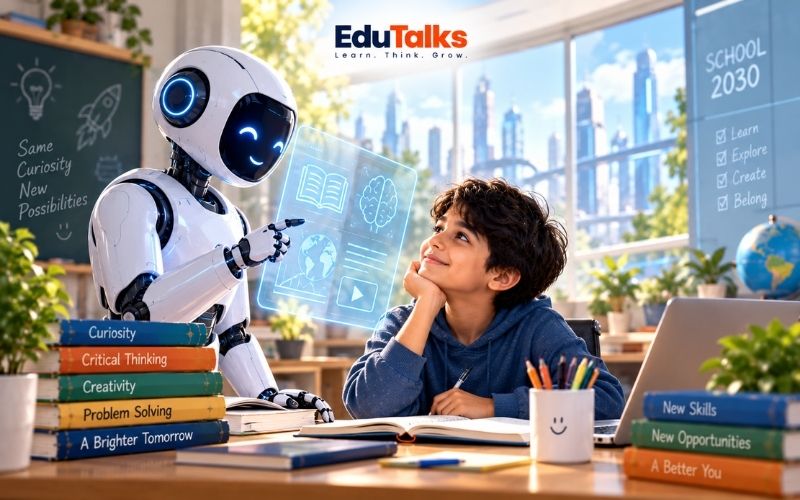
The School of 2030 Will AI Become Your Teacher?
The School of 2030
Will AI Become Your Teacher?
AI may not replace teachers by 2030—but it will change how schools teach. Discover the AI tutor, human teacher and classroom taking shape across India—soon too.
Imagine walking into a classroom in 2030.
There is still a teacher at the front of the room. Students are still asking questions. There are still notebooks, projects, friendships, arguments and the occasional forgotten homework.
But something has changed.
One student is learning mathematics with an AI tutor that patiently explains the same problem five different ways. Another is practising English with an AI conversation partner. A teacher is using AI to understand which students are struggling with a particular concept. Somewhere else, a student is asking an AI system a question that would once have required a trip to the library.
The classroom of 2030 may not look like a science-fiction movie. It may look surprisingly normal.
And that is exactly why the biggest question is no longer, “Will AI enter schools?”
The real question is: What will schools do with it?
“The future classroom may not be teacher versus AI. It could be teacher + AI.”
First, let’s kill one popular idea
Whenever people talk about AI and education, one dramatic prediction appears again and again: AI will replace teachers.
It sounds futuristic. It also makes for a great headline.
But education is much more complicated than delivering the right answer.
A teacher does not simply explain photosynthesis or solve quadratic equations. A teacher notices when a student has stopped participating. A teacher knows when a child needs encouragement rather than another worksheet. A teacher understands classroom relationships, motivation, confidence, behaviour and context.
AI can process information incredibly quickly. It can explain, generate, translate, personalise and provide feedback. But education is also a human relationship.
UNESCO has repeatedly emphasised a human-centred approach to AI in education, while recent OECD work argues that AI should strengthen teaching rather than quietly replace the cognitive work and human relationships at the heart of learning.
Meet the AI tutor
The most interesting change may happen beside the teacher, not instead of the teacher.
Think about a student who is struggling with fractions.
In a traditional classroom, the teacher may explain the concept to the entire class. The student might understand it—or might simply copy the answer and move on.
An AI learning system could potentially give that student additional practice, change the explanation, provide examples connected to the student's level and keep working through the problem without getting tired.
For another student who already understands the topic, the same system could provide a more challenging problem.
Same classroom. Different learning paths.
This is one of the most promising possibilities of AI in education: personalised support at a scale that would be difficult for one teacher to provide alone.
India's education discussions are already moving in this direction. Government discussions around AI in education have highlighted possibilities such as personalised assistance, regional-language learning, home-based learning and AI-supported tutoring.
What could an AI tutor actually do?
- Explain the same concept in different ways
- Give personalised practice questions
- Help students practise languages
- Provide instant feedback
- Support students outside school hours
- Help identify areas where a learner needs more support
But there is a catch
AI can make a student look smarter without necessarily making the student smarter.
That distinction could become one of the biggest education debates of the decade.
A student can ask AI to write an essay. The essay may be excellent. But did the student learn how to structure an argument?
A student can ask AI to solve a mathematics problem. The answer may be correct. But can the student solve a similar problem alone during an examination?
A student can generate a brilliant presentation in minutes. But can they stand in front of the class and explain it?
This is where the future of education becomes much more interesting than simply “using AI”.
The challenge will be teaching students when to use AI, how to question AI, how to verify AI and when not to use AI at all.
The OECD's 2026 Digital Education Outlook makes a similar distinction: using general-purpose generative AI can improve the quality of a student's output without necessarily producing learning gains. Educational AI works better when it is used with a clear teaching purpose.
The future skill may not be “knowing AI”. It may be knowing when not to trust it.
So what happens to the teacher?
Perhaps the better question is: what happens to the teacher's job?
Imagine AI handling some of the repetitive work—creating first drafts of lesson plans, generating practice questions, helping organise learning resources or providing basic feedback.
That could give teachers more time for the things that machines struggle to reproduce: conversations, mentoring, classroom culture, creativity, encouragement, discussion and understanding individual students.
The teacher could become less of a person who simply delivers information and more of a person who designs learning.
In other words, the teacher of 2030 may not disappear.
The teacher may become more important—but in a different way.
What could a classroom in 2030 look like?
There probably will not be one universal “Classroom 2030”. Different schools will adopt technology at different speeds.
But a possible school day might look something like this:
Students begin the day with their teacher, classmates and discussions—not a chatbot.
AI-supported tools help students practise at different levels while the teacher works closely with students who need help.
Students solve problems, discuss ideas, write, experiment and think without relying on AI.
Students learn how AI works, where it can fail, how to verify information and how to use it responsibly.
Collaboration, communication, creativity, sports, arts and real-world projects remain central to school life.
And India has a particularly big opportunity
India's education system is incredibly diverse. A classroom in Bengaluru can look very different from one in a small town, village or remote district.
That makes AI both exciting and challenging.
AI could help bring learning support to students who do not have access to expensive coaching or specialist teachers. Regional-language tools could make educational content more accessible. Students could potentially get additional help at home rather than waiting until the next day to ask a question.
But technology alone cannot solve inequality.
A student without reliable internet, a suitable device, digital guidance or a safe learning environment may not benefit in the same way as a student who has all four.
So the question for Indian schools is not simply, “Can we use AI?”
It is: “Can we use AI without creating a bigger gap between students?”
Ask the three people who matter most
Will AI make learning easier—or make us lazy?
If AI can give you an answer instantly, the real advantage may belong to the student who knows how to ask better questions, challenge the answer and then think independently.
Will AI reduce workload—or change the profession?
Teachers who understand how to use AI thoughtfully could gain a powerful assistant. But they will also need new skills, new assessment methods and new ways of protecting genuine learning.
Should your child use AI?
The answer may not be “yes” or “no”. The better question is whether your child is using AI to understand something—or simply using it to avoid doing the thinking.
The school of 2030 may be less about technology than we think
Here is the strange part.
We may enter an age where information becomes almost unlimited.
If every student can ask an AI system to explain a historical event, translate a paragraph, practise a language or generate a basic answer, then simply having information will become less valuable.
What becomes more valuable is knowing what to do with that information.
Can you think critically?
Can you spot a wrong answer?
Can you explain your reasoning?
Can you work with other people?
Can you create something original?
Can you make an ethical decision when technology gives you an easy shortcut?
These are not skills that become less important because AI exists.
They become more important because AI exists.
Don't ask whether AI will become your teacher.
Ask whether your teacher, your school and you are ready to learn alongside it.
The school of 2030 will probably not be a room full of robots. It will still have teachers, students, books, playgrounds, laboratories, friendships and human conversations.
But AI will be sitting somewhere in that picture.
The schools that succeed may not be the ones that use the most technology. They may be the ones that understand where technology helps—and where humans must remain at the centre.
The future classroom is already arriving.
The question is whether we are ready for it.
In 30 Seconds
- AI is likely to change teaching, not simply replace teachers.
- AI tutors could provide personalised learning support.
- Students will need AI literacy alongside traditional academic skills.
- Schools must protect independent thinking and genuine learning.
- Teachers could use AI to reduce repetitive work and focus more on students.
- The future of education is likely to be human + AI, not human vs AI.
OECD — Digital Education Outlook 2026: Exploring Effective Uses of Generative AI in Education
OECD — What Should Teachers Teach and Students Learn in a Future of Powerful AI?
UNESCO — AI and the Future of Education
Ministry of Education, Government of India — AI for Education discussions and initiatives