
15 Careers You Haven’t Heard About Yet Explore New-Age Opportunities
15 Careers You Haven’t Heard About Yet
Explore New-Age Opportunities
Doctor. Engineer. Lawyer. CA. Teacher. These are familiar career choices. But the world of work is getting bigger—and some of the most interesting careers of tomorrow don't sound like traditional jobs at all.
```Ask a 10-year-old what they want to become.
You will probably hear some familiar answers.
Doctor. Engineer. Pilot. IAS officer. Teacher. Army officer. Maybe cricketer, actor or YouTuber.
There is nothing wrong with any of them.
But here's the interesting question:
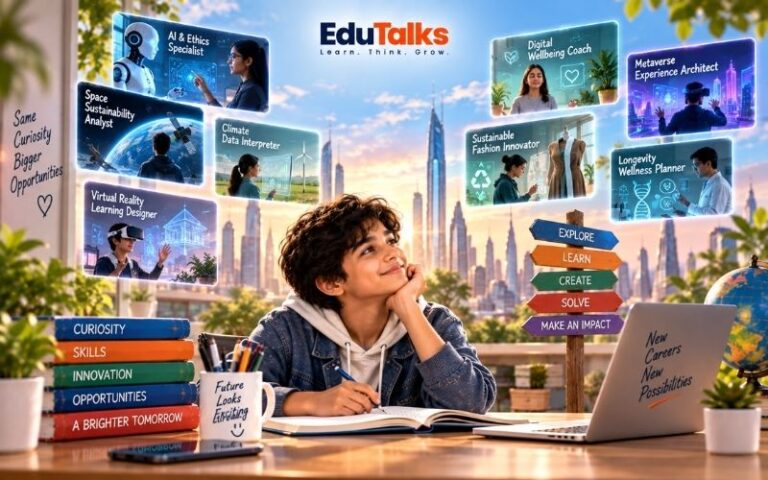
What if your dream job doesn't have a familiar name yet?
Technology is creating new industries, changing old ones and combining skills that were once completely separate.
Artificial intelligence needs people who understand technology—but it also needs people who understand law, design, psychology, communication, ethics and business.
The result is a fascinating new career landscape.
Some of tomorrow's best opportunities may be careers today's students have never heard of.
AI Product Manager
Who decides what an AI-powered product should actually do?
An AI product manager sits between technology, business and users. They help define the problem, understand what customers need, work with technical teams and decide how an AI product should be developed.
You don't necessarily need to be the person writing every line of code.
You need to understand people, products, technology and problems.
AI Ethics Specialist
What happens when an AI system makes a decision that affects a real person?
AI ethics specialists examine questions around fairness, bias, privacy, safety, accountability and responsible use of artificial intelligence.
As AI becomes part of education, healthcare, finance, recruitment and government services, these questions become harder to ignore.
If technology becomes more powerful, someone has to ask whether it is being used responsibly.
Data Storyteller
A spreadsheet can contain thousands of numbers. But numbers alone rarely persuade people.
Data storytellers turn complex information into understandable narratives using visualisation, analysis and communication.
Businesses, governments, researchers and news organisations all need people who can explain what data actually means.
It's where mathematics meets storytelling.
Prompt Engineer / AI Workflow Specialist
AI systems can produce dramatically different results depending on how people instruct and structure tasks for them.
People working in this area design effective instructions, workflows and processes for generative AI systems and help organisations use AI more effectively.
The field is evolving quickly, so the long-term career title may change.
The bigger skill is learning how to turn human goals into useful AI workflows.
Cybersecurity Threat Hunter
Imagine being paid to think like a hacker—but use that thinking to protect organisations.
Threat hunters look for suspicious activity and signs of attacks that automated systems may miss.
They combine technical knowledge, investigation and pattern recognition.
It is part detective work, part technology and part constant learning.
Sustainability Consultant
Companies are increasingly being asked to understand their environmental impact and change how they operate.
Sustainability professionals help organisations work on issues such as energy use, emissions, waste, supply chains and environmental strategy.
This career can bring together science, business, policy and problem-solving.
Saving the planet can also become a professional discipline.
Space Data Analyst
Space exploration produces enormous amounts of information—from satellites, Earth observation systems and scientific missions.
Data professionals can help turn that information into useful insights for science, agriculture, climate monitoring, communications and more.
You don't have to become an astronaut to build a career connected to space.
Digital Health Specialist
Healthcare is becoming increasingly connected to software, data, wearable devices, telemedicine and artificial intelligence.
Digital health professionals can work across technology and healthcare to design, implement or improve digital solutions for patients and healthcare organisations.
The hospital of the future will need more than doctors and nurses.
Immersive Experience Designer
Virtual and augmented reality can change how people learn, shop, train, play and interact.
Immersive experience designers think about what a person sees, hears and does inside digital environments.
It combines design, technology, psychology and storytelling.
The future of design may not always happen on a flat screen.
Human-Robot Interaction Designer
A robot may be technically brilliant and still be difficult for humans to use.
Human-robot interaction specialists focus on how people communicate and work with robotic systems.
As robots enter factories, hospitals, homes and other environments, designing that relationship becomes increasingly important.
The future isn't only about building robots. It is about making humans and robots work well together.
Alternative Protein Scientist
How do we feed a growing population while using resources more efficiently?
Scientists and food technologists are exploring plant-based proteins, fermentation, cultivated meat and other approaches to future food production.
Food science is becoming a technology story as much as a farming story.
Climate Risk Analyst
Climate change creates risks for cities, businesses, infrastructure, agriculture and financial systems.
Climate risk analysts study data and help organisations understand how environmental changes could affect decisions and investments.
Climate science increasingly connects with economics, finance and business strategy.
Genomic Data Specialist
Modern biology can produce enormous quantities of genetic data.
Specialists in genomics and bioinformatics help analyse biological information and support research in areas such as disease, agriculture and personalised medicine.
It is a powerful example of biology meeting computing.
Learning Experience Designer
Education is no longer limited to textbooks and classrooms.
Learning experience designers create educational experiences for schools, universities, companies, apps and online platforms.
They combine psychology, technology, communication and instructional design.
If you love learning but don't want to be a traditional teacher, this is a career worth exploring.
Digital Reputation Strategist
In a world where people and organisations are searched online before they are trusted, reputation has become a digital asset.
Reputation professionals work on how individuals, brands and organisations communicate and manage their public presence across digital platforms.
The work can involve communication, media, content, search and crisis management.
Your digital reputation may become as important as your physical reputation.
Don't choose a career only by its name.
Choose it by the problems you want to solve, the people you want to help and the kind of work you want to spend your life doing.
```And what about India?
For Indian students, the career landscape is becoming especially interesting.
India's technology sector, startup ecosystem, digital public infrastructure, space programme, healthcare technology and sustainability efforts are creating opportunities across disciplines.
But there is an important warning.
Every few years, a new career becomes the “hot career”. Suddenly everyone wants to become a data scientist, AI engineer or something else that appears to be in demand.
That is not how good career decisions work.
Don't chase the job of the year. Build the skills that allow you to adapt to the jobs of the next twenty years.
A message for parents
One of the most difficult things for parents is guiding a child towards a career they themselves have never heard of.
That's understandable.
A parent can confidently explain what a doctor does. An engineer makes sense. A lawyer makes sense.
But what exactly does an AI product manager do? What does a climate risk analyst do? Where does a learning experience designer work?
The answer isn't to know every new job.
The answer is to become comfortable exploring careers together.
Ask your child what problems they enjoy solving. What subjects make them curious? What kind of work would they enjoy doing every day?
A career conversation should begin long before the college application form appears.
Your career does not have to fit inside a box labelled “Science”, “Commerce” or “Arts”.
Some of the most interesting careers combine multiple subjects. Biology can meet computing. Design can meet technology. Psychology can meet AI. Environmental science can meet finance. Communication can meet technology.
```How do you explore a career before choosing it?
The biggest career mistake may not be choosing the wrong career.
It may be never discovering that other careers existed.
```The world of work is changing faster than most career lists can keep up.
Some job titles on this list may become mainstream. Some may evolve into something completely different. New ones will appear that we haven't even named yet.
That's okay.
Because the point isn't to predict the perfect job for every student.
The point is to make the career map bigger.
So the next time someone asks a student, “What do you want to become?”, perhaps the answer doesn't have to be one word.
It can begin with a question:
“What problems do I want to solve?”
In 30 Seconds
```- Technology is creating new roles across AI, data, healthcare, climate, space and education.
- Many future careers combine two or more traditional disciplines.
- Students should explore careers through skills and problems, not job titles alone.
- Parents can help by exploring unfamiliar career paths with their children.
- No career list can perfectly predict the job market of 2030.
- The most future-ready skill may be the ability to keep learning and adapting.
World Economic Forum — Future of Jobs Report
International Labour Organization — Future of Work
OECD — Skills, Education and Future of Work
```