What Makes a School Great? Beyond Buildings, Smart Boards & 100% Results
What Makes a School Great?
Beyond Buildings, Smart Boards & 100% Results
A great school is not simply the one with the biggest campus or the highest marks. It is the place where students feel safe to ask, fail, discover, grow and become themselves.
```Walk into a school for the first time and you will probably notice the building before anything else.
The entrance. The reception. The playground. The laboratories. The smart classrooms. The trophies displayed behind glass. Perhaps a giant board proudly announcing last year's examination results.
It all looks impressive.
But here is a question worth asking:
If you removed the building, the smart boards and the trophies—would the school still be great?
That question changes everything.
Because schools are not really buildings.
Schools are people, relationships, experiences and opportunities.
The school report card doesn't tell the whole story
When parents compare schools, numbers are tempting.
Board results. Average marks. Number of students scoring 90% or above. Olympiad medals. Competitive examination selections. University admissions.
Numbers are useful. They tell us something.
But they cannot tell us everything.
A school's academic results do not automatically tell you whether a nervous child feels comfortable asking a question in class. They don't tell you whether teachers know their students well. They don't tell you whether students are encouraged to think differently or whether they are simply trained to reproduce the expected answer.
And they certainly don't tell you what happens to the student who doesn't come first.
A great school should know what to do with both the topper and the struggling student.
“The real test of a school is not only how it treats its best students. It is how it helps every student move forward.”
Students are allowed to ask “Why?”
Walk into an excellent classroom and listen carefully.
Is the teacher doing all the talking?
Or are students explaining, questioning, debating, experimenting and solving?
A strong classroom does not treat curiosity as disruption. It treats curiosity as part of learning.
Students should not be afraid that asking a difficult question will make them look foolish.
If students are scared of being wrong, they may stop trying to be right.
```Teachers know more than the subject
A great mathematics teacher knows mathematics.
A great science teacher understands science.
But great teachers also understand children.
They notice when a normally talkative student suddenly becomes quiet. They recognise when a student understands the answer but lacks confidence. They know that two children can need completely different explanations for the same concept.
Technology can support teaching. Textbooks can support teaching. Infrastructure can support teaching.
But the teacher-student relationship remains at the heart of education.
```Students are allowed to fail safely
This sounds strange.
Aren't schools supposed to help students succeed?
Of course.
But students cannot become confident problem-solvers if every mistake is treated as something embarrassing.
A science experiment that doesn't work can teach something. A debate argument that falls apart can teach something. A failed project can teach something.
The goal isn't to celebrate failure for its own sake.
The goal is to make failure useful.
```There is life beyond the textbook
A student's education should not end when the school bell rings.
Sports teach teamwork and discipline. Theatre builds confidence. Music develops expression. Debate teaches argument. Art develops observation. Projects teach students how to turn an idea into something real.
A great school gives these experiences genuine value rather than treating them as decoration around academics.
Education is bigger than the subjects listed on a timetable.
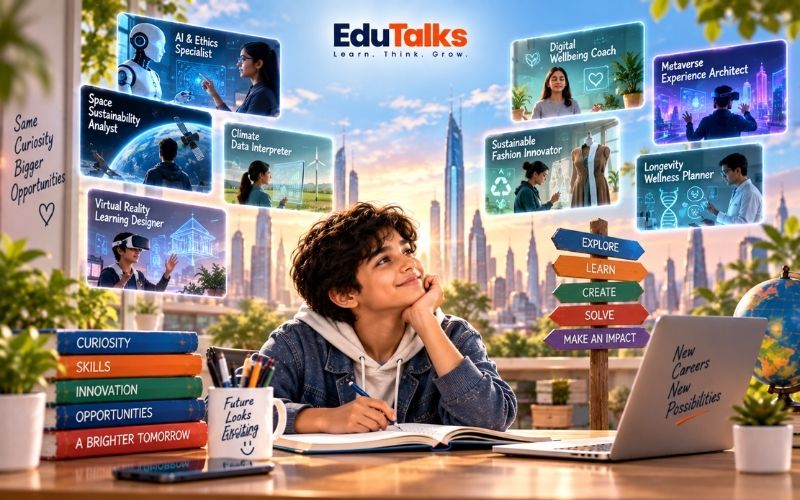
```The school prepares students for a world that doesn't exist yet
This may be one of the hardest jobs a school has.
Nobody knows exactly what the workplace of 2040 will look like.
Artificial intelligence is changing how people work. New careers are appearing. Existing careers are being redesigned. Information is becoming easier to access while misinformation is becoming harder to identify.
A future-ready school therefore cannot only teach students what is known.
It must teach them how to learn what they don't know.
```The quiet student matters too
School culture can sometimes revolve around the loudest students, highest scorers and most visible achievers.
But every classroom has students who rarely raise their hands. Students who are brilliant at drawing but average at mathematics. Students who understand everything but are terrified of speaking. Students who need more time.
A great school makes room for different kinds of intelligence, different personalities and different learning journeys.
Not every child needs to shine in the same way.
```Parents are partners, not customers
Choosing a school can sometimes feel like shopping.
Compare facilities. Compare fees. Compare results. Compare activities.
But education works differently from buying a product.
The strongest schools build meaningful relationships with parents. They communicate when things are going well and when they are not. They listen. They explain. They work with families rather than treating them as outsiders.
A child's education becomes stronger when school and home stop working in separate worlds.
```Students have a voice
Ask students what they think about their school.
Not through a once-a-year formal survey that nobody reads.
Actually ask them.
What makes you excited to come to school? What makes learning difficult? Which rules make sense? Which don't? What would you change?
Students do not run schools. Adults have responsibilities that students cannot carry.
But students are the people experiencing school every day. Their perspective matters.
```Technology serves learning—not the other way around
A smart board does not automatically create a smart classroom.
A tablet does not automatically create better learning.
Artificial intelligence will not automatically create better education either.
Technology becomes valuable when it solves a real educational problem: helping a student understand a difficult concept, giving a teacher useful insight, making learning more accessible or creating opportunities that were previously impossible.
The question should never be “What technology do we have?” It should be “What does this technology help students do better?”
```Students actually want to be there
This may sound almost too simple.
But ask a student how school feels.
Do they feel safe? Seen? Respected? Challenged? Curious?
Do they have at least one adult in school they can approach when something goes wrong?
Do they have friends? Do they have moments of fun? Do they feel that school is somewhere they belong?
A school can produce excellent results and still fail to create a good experience of childhood.
```The Great School Test
Forget the brochure for a moment.
If you want to understand whether a school is genuinely great, ask these questions:
Don't only ask, “How good is this school?”
Ask, “How does my child become a different person because of this school?”
```“If students remember only one thing about my classroom ten years from now, what should it be?”
```“If you could change one thing about your school, what would it be—and why?”
```The best school may not be the one with the most impressive brochure.
It may be the one where a child becomes more curious, more confident, more capable and more prepared for life.
```Buildings can be upgraded.
Smart boards can become outdated.
Rankings can change.
Even examination systems will evolve.
But the purpose of a great school is remarkably timeless.
It should help young people discover what they are capable of—and give them the knowledge, confidence and character to do something meaningful with it.
Perhaps that is the real measure of a school.
Not how impressive it looks from the outside.
But who its students become on the inside.
In 30 Seconds
```- Great schools are about more than buildings, technology and examination results.
- Strong teacher-student relationships are central to effective education.
- Students need opportunities to question, create, collaborate and make mistakes safely.
- Schools should prepare students for life and work beyond examinations.
- Parents and students should have a meaningful voice in school life.
- A truly great school helps students become curious, confident, capable and independent.
OECD — Future of Education and Skills
UNESCO — Education, Teachers and Learning
National Education Policy 2020 — Government of India
```