10 Skills for 2030 Skills That Could Be Worth More Than Your Marks
10 Skills for 2030
Skills That Could Be Worth More Than Your Marks
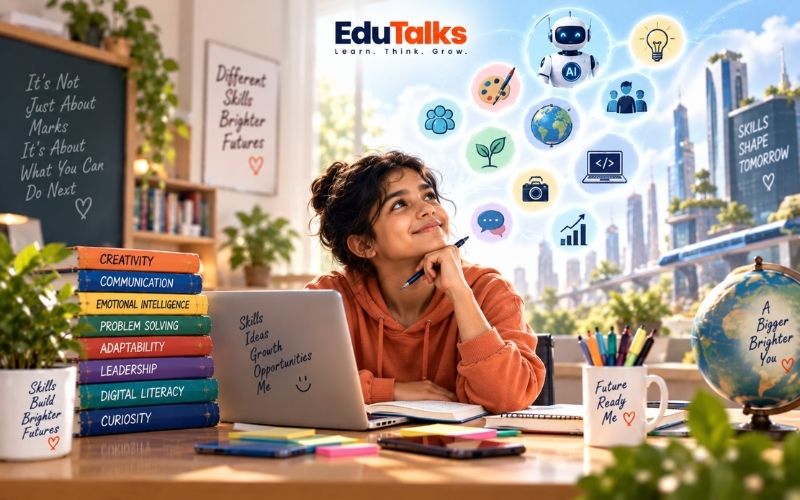
Marks still matter. But as AI changes jobs and industries, the ability to think, communicate, create, adapt and solve real problems could matter even more.
```Imagine two students applying for the same job in 2030.
Student A has excellent marks. Their certificates are impressive. They can remember information quickly and perform well in examinations.
Student B has good academic results—but can also explain complicated ideas clearly, use AI intelligently, solve unfamiliar problems, work with different people and build something from scratch.
Who would you hire?
There is no easy answer. Academic knowledge will continue to matter. Doctors will still need to understand medicine. Engineers will still need mathematics. Teachers will still need subject knowledge.
But the world around that knowledge is changing rapidly.
By 2030, knowing the answer may be less impressive than knowing what to do with it.
“Your marks show what you learned. Your skills show what you can do.”
So, what will actually matter?
The World Economic Forum's Future of Jobs research identifies a combination of analytical thinking, creative thinking, resilience, flexibility, leadership, technological literacy and other human-centred capabilities among the skills employers increasingly value.
But rather than giving you another boring list of corporate buzzwords, let's translate those ideas into something a school student can actually understand.
Critical Thinking
AI can give you an answer in seconds. Search engines can give you thousands of answers. Social media can give you millions of opinions.
So the valuable person will be the one who asks: Is this actually true?
Critical thinking means examining evidence, questioning assumptions, spotting weak arguments and reaching your own conclusion.
Try this: Next time you receive an impressive-looking answer from AI, don't ask only “What is the answer?” Ask “How do we know?”
Communication
You may have the world's best idea. If you cannot explain it, convince someone about it or present it clearly, the idea may go nowhere.
Communication is more than speaking good English. It includes listening, writing, presenting, storytelling and knowing how to communicate with different people.
The future will need students who can turn complicated ideas into simple ones.
AI Literacy
You don't necessarily need to become an AI engineer.
But understanding how to use AI responsibly could become as important as knowing how to use a computer.
AI literacy means knowing what AI can do, where it can fail, how to write useful prompts, how to check its answers, how to protect personal information and when human judgement should take over.
In 2030, “I know how to use AI” may not be impressive. “I know how to use AI well” will be.
Creativity
When machines can generate text, images, videos, presentations and even computer code, creativity does not become useless.
It becomes more valuable.
Creativity is not simply drawing or making art. It is the ability to see possibilities that others haven't noticed and connect ideas in new ways.
Don't just ask AI to create something. Learn to decide what is worth creating.
Problem-Solving
School often gives you a problem and teaches you the method to solve it.
Real life often gives you the problem first—and asks you to figure out the method.
That difference matters.
Problem-solving means breaking a difficult situation into smaller pieces, testing possibilities, learning from failure and finding a workable solution.
The best problem solvers don't panic when they don't know the answer. They know how to find their way towards one.
Adaptability
The job you prepare for at 16 may look very different by the time you are 26.
New technologies will appear. Some jobs will change. New careers will emerge. Entire industries will reinvent themselves.
Adaptability means being comfortable learning something new—even when you are not initially good at it.
Don't build your identity around one skill. Build the ability to learn new skills.
Collaboration
The myth of the lone genius is slowly becoming less useful.
The biggest problems in the world—from climate change to healthcare to technology—are too complicated for one person to solve alone.
Students who know how to listen, disagree respectfully, share responsibility and build with others will have a serious advantage.
Teamwork isn't just a school project skill. It is a life skill.
Emotional Intelligence
Machines can analyse information. Humans still have to deal with humans.
Emotional intelligence includes understanding your own emotions, recognising what others may be feeling, managing reactions and building healthy relationships.
It matters in classrooms, friendships, workplaces, leadership and family life.
Being smart is useful. Knowing how to work with people is powerful.
Financial & Digital Awareness
Your first salary may be years away. Your financial decisions have already begun.
Students are growing up surrounded by digital payments, online shopping, subscriptions, investing apps, advertising, influencers and increasingly sophisticated scams.
Understanding money, privacy, cybersecurity, digital footprints and basic financial decisions will become increasingly important.
Knowing how to earn money is only half the game. Knowing how to manage it matters too.
Curiosity
This might be the most underrated skill on the list.
Curious people keep asking questions. They explore subjects outside their syllabus. They read things because they are interested—not because there is an examination tomorrow.
And in a world where knowledge changes constantly, curiosity creates a habit that never becomes outdated: learning.
The student who keeps learning after the exam may eventually outperform the student who only learned for the exam.
The 10 skills at a glance
| Skill | Why it matters |
|---|---|
| Critical Thinking | Separate facts from noise |
| Communication | Turn ideas into influence |
| AI Literacy | Work intelligently with AI |
| Creativity | Imagine what doesn't exist yet |
| Problem-Solving | Handle unfamiliar challenges |
| Adaptability | Keep learning as the world changes |
| Collaboration | Build with other people |
| Emotional Intelligence | Understand yourself and others |
| Financial & Digital Awareness | Navigate modern life safely |
| Curiosity | Keep learning beyond school |
Does this mean marks don't matter?
```Absolutely not.
Good academic performance can demonstrate discipline, knowledge, consistency and subject understanding. Competitive examinations and many professional courses will continue to require strong academic foundations.
The mistake is thinking marks and skills are opposites.
```The strongest students of the future may be those who develop both.
Study for the examination. But also learn to speak. Build something. Solve a real problem. Work with people. Question information. Use technology. Read outside the syllabus. Fail at something difficult. Try again.
Because a report card can tell a university what you scored at 17.
It cannot tell the whole story of what you can become at 27.
What does this mean for Indian students?
India has one of the world's largest young populations. Millions of students are preparing today for a working world that will look different from the one their parents entered.
That makes the conversation around future skills especially important.
A student from Delhi, a small town in Rajasthan, a village in Bihar or a school in Kerala may not have the same resources. But many future skills are remarkably accessible.
You can practise communication by speaking. You can practise curiosity by reading. You can practise problem-solving by building things. You can develop creativity by making things. You can develop teamwork by playing sport or working on projects. You can develop critical thinking simply by questioning what you see online.
The future is not reserved for students with the most expensive technology.
Often, it begins with habits.
A challenge for schools—and parents
If we genuinely want students to develop future-ready skills, education cannot become only a race for higher marks.
Schools need opportunities for projects, presentations, debates, experiments, entrepreneurship, teamwork, creativity and real-world problem-solving.
Parents can help too.
Instead of asking only, “How many marks did you get?”, sometimes ask:
“What did you learn today that wasn't in the textbook?”
“What problem did you solve?”
“What did you disagree with?”
“What did you create?”
“What would you like to learn next?”
Don't prepare students only for the next examination.
Prepare them for the world that begins after it.
```Nobody knows exactly what the job market of 2030 will look like.
That is precisely why students should not try to predict every future job.
Instead, they should build abilities that travel with them from one opportunity to the next.
Technology will change. Jobs will change. Industries will change. Even the skills we consider “new” today may become ordinary tomorrow.
But the ability to think, communicate, create, learn and adapt will never go out of fashion.
Your marks are part of your story. They don't have to be the whole story.
In 30 Seconds
```- Academic knowledge will remain important.
- Future jobs will increasingly reward both technical and human skills.
- AI literacy will become increasingly important for students.
- Critical thinking can help students navigate an information-rich world.
- Communication, creativity and collaboration cannot be ignored.
- Curiosity and adaptability may be the skills that keep every other skill relevant.
World Economic Forum — Future of Jobs Report
OECD — Skills Outlook and Future of Education research
UNESCO — AI, Education and Future Skills
```