

NEP 2020: Top Changes Indian Schools Must Apply in 2025
Understanding NEP 2020: What Schools Must Implement by 2025

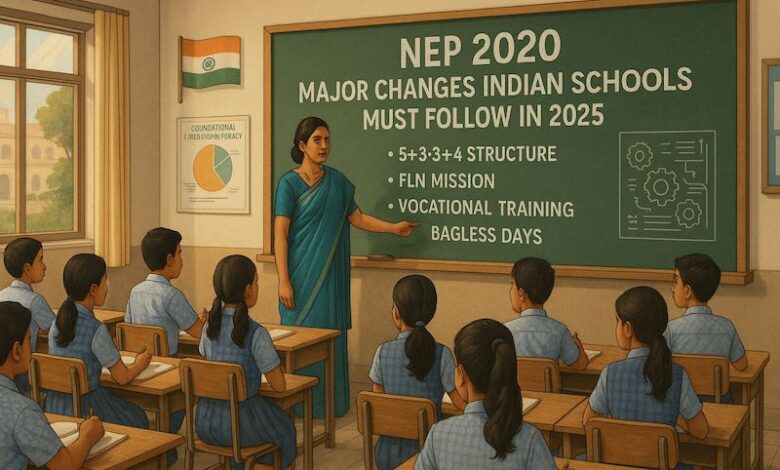
The National Education Policy (NEP) 2020 is one of the most transformative reforms in the history of Indian education. As we step into 2025, the Ministry of Education has initiated key milestones to be implemented across schools — aiming to make education more inclusive, practical, and future-ready.
Whether you’re a school principal, teacher, student, or parent, understanding these NEP 2020 mandates for 2025 is crucial. This blog will break down the top changes schools must adopt this year — along with official references, benefits, and practical insights.
✅ 1. Shift from 10+2 to 5+3+3+4 Structure
What It Means:
The traditional 10+2 system is being replaced by a 5+3+3+4 structure, categorizing learning stages as:
- Foundational Stage (Ages 3–8): Preschool + Grade 1-2
- Preparatory Stage (Ages 8–11): Grades 3-5
- Middle Stage (Ages 11–14): Grades 6-8
- Secondary Stage (Ages 14–18): Grades 9-12
Why It Matters in 2025:
By 2025, schools are required to align their academic calendar and curriculum with this structure. This brings Anganwadis, preschool, and primary schools under the same policy umbrella for the first time.
Reference: Ministry of Education – NEP 2020 Overview
✅ 2. Foundational Literacy and Numeracy (FLN) – Mission “NIPUN Bharat”
What It Means:
The goal is that every child in Grade 3 should achieve foundational literacy and numeracy by 2026–27.
What’s Required in 2025:
- Schools must run NIPUN Bharat programs in early grades.
- Teachers are required to use interactive teaching methods and track progress via FLN assessment tools.
Why It Matters:
FLN is the base for all learning. Without it, a child’s future education is at risk.
Reference: NIPUN Bharat Guidelines (gov.in)
✅ 3. Multilingual Education Till Grade 5
What It Means:
NEP promotes mother tongue/regional language as the medium of instruction up to Grade 5, and preferably till Grade 8.
What Schools Must Do in 2025:
- Schools should ensure local language integration in primary grades.
- Bilingual teaching aids and teacher training are encouraged.
- Parents must be informed about the benefits of multilingual learning.
Why It Matters:
This change supports better understanding, emotional bonding, and learning equity.
Reference: NEP 2020 Full Document – pg. 13-14
✅ 4. Emphasis on Vocational Education
What It Means:
From Grade 6 onwards, students will experience hands-on vocational training, including coding, carpentry, gardening, electronics, etc.
In 2025, Schools Should:
- Implement at least one vocational module in Grades 6-8.
- Partner with local artisans or startups for practical exposure.
- Encourage students to complete internships during holidays.
Why It Matters:
This move reduces the theory-practice gap and promotes employability skills early.
✅ 5. Holistic Progress Card (HPC)
What It Means:
NEP introduces a 360-degree assessment system, known as the Holistic Progress Card, to replace outdated marks-based report cards.
Implementation in 2025:
- Schools must develop new report formats showing academics, co-curriculars, life skills & emotional growth.
- Peer and self-assessment are now included in evaluations.
- Use of technology-enabled dashboards is promoted.
Why It Matters:
This aligns with the NEP’s vision of holistic and multidimensional learning.
✅ 6. Bagless Days & Experiential Learning
What It Means:
NEP encourages “Bagless Days” in schools where students engage in:
- Field visits
- Skill-based activities
- Internship-like projects
Action in 2025:
- Schools must dedicate 10–15 days per year for Bagless Days.
- Develop structured activity calendars around real-world applications.
Why It Matters:
This encourages curiosity, creativity, and hands-on understanding.
✅ 7. Teacher Training & Professional Development
NEP Goal:
Teachers must become facilitators of learning rather than just instructors.
What to Do in 2025:
- Teachers should complete 50 hours of CPD (Continuous Professional Development) annually.
- Enroll in NISHTHA and DIKSHA training platforms.
- Schools must allocate time and budget for teacher upskilling.
Reference: DIKSHA Portal
✅ 8. Integration of Technology in Classrooms
Tech-Push in NEP:
From AI and gamification to digital boards and smart content, NEP 2020 stresses on digital learning.
In 2025:
- Schools must adopt Blended Learning Models.
- Encourage use of platforms like SWAYAM, PM eVidya, and DIKSHA.
- Use AI-driven assessments where possible.
Reference: SWAYAM Platform – MHRD
✅ 9. Flexible Curriculum and Choice-Based Subjects
New Model:
NEP allows students to choose combinations of subjects beyond rigid streams (Science, Commerce, Arts).
Expected in 2025:
- Grade 9–12 students should be offered interdisciplinary options.
- Promote critical thinking, entrepreneurship, and design thinking in senior secondary classes.
Why It Matters:
This ensures students follow their passion and aptitude, not just scores.
✅ 10. Inclusive & Equitable Education
Policy Focus:
Schools must become inclusive of all socio-economic backgrounds, with special attention to girls, SC/ST, and disabled students.
What to Do in 2025:
- Implement gender sensitivity workshops and inclusive teaching practices.
- Ensure infrastructure access for differently-abled students.
- Build inclusive classrooms with diverse learning aids.
📝 Final Thoughts: NEP 2020 as a Roadmap to Educational Transformation
The implementation year of NEP 2020 is not just a deadline — it’s a turning point. Indian schools that embrace these changes will not only comply with regulations but also redefine education for the 21st century.
EduTalks.in will continue to bring detailed updates, case studies, and resources to support schools, teachers, and educationists in this transformative journey.
🔗 Official References for Further Reading: